
0W-12 vs 0W-20: Why the Second Number Matters
You're standing in front of two bottles. One says 0W-12, the other says 0W-20. They start with the same "0W", they're both full synthetic, and the price is close. So does the second number really matter?
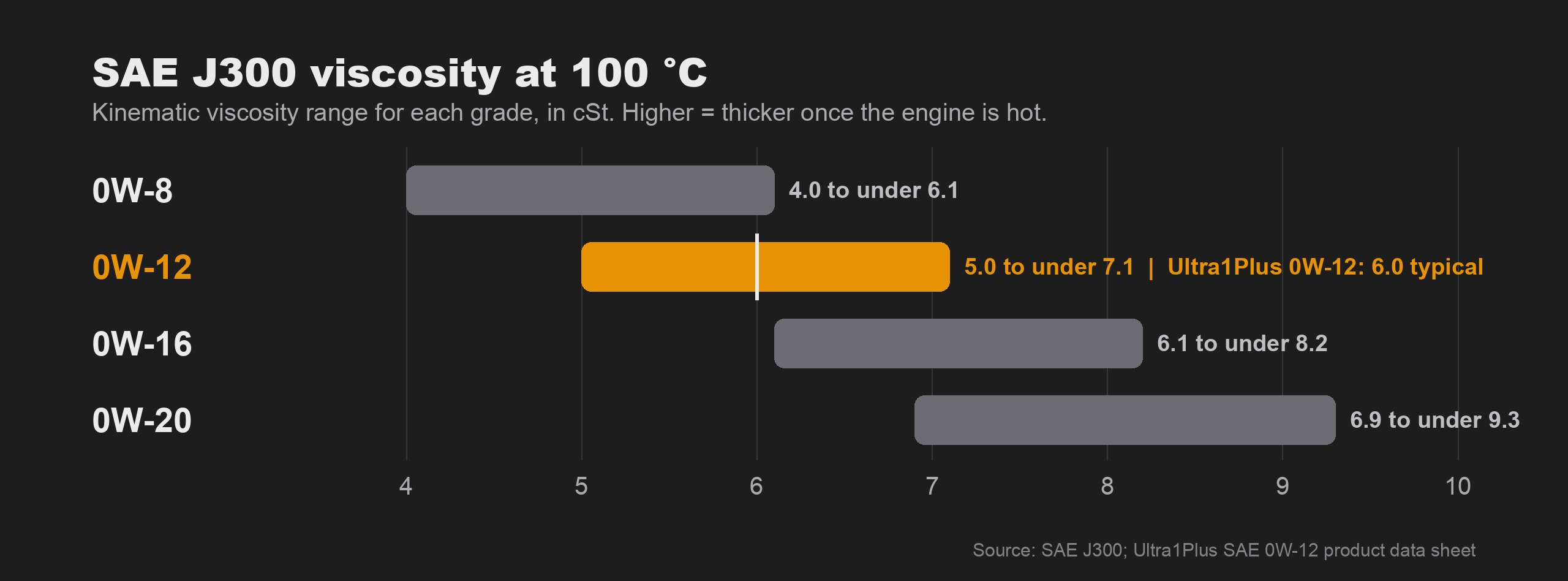
Short answer: 0W-12 and 0W-20 flow the same on a cold start, but 0W-12 is thinner once the engine is hot. Under SAE J300, a 0W-12 measures 5.0 to under 7.1 cSt at 100 °C and a 0W-20 measures 6.9 to under 9.3 cSt. Use the grade your owner's manual specifies.
That one number tells you how thick the oil stays once your engine is hot, and modern engines are built around it. Here's what it means, how the two grades compare, and how to pick the one your engine needs.
Part 1: What the two numbers on the bottle mean
What is a viscosity grade? It's a rating from the SAE J300 standard that tells you how easily an oil flows. Every multigrade oil has two parts.
The "0W" is the winter rating. It tells you how well the oil flows and pumps on a cold start. 0W-12 and 0W-20 share it, so on a cold morning they behave about the same.
The "12" or the "20" is the viscosity at operating temperature, measured at 100 °C. A lower number means a thinner oil once the engine is warm.
Why it matters: most engine wear happens at two moments, the cold start and the long hot run. The first number covers the first moment. The second number covers the second.
Part 2: How 0W-12 and 0W-20 compare
How much thinner is 0W-12? Here are the limits SAE J300 sets for each grade:
| Grade | Viscosity at 100 °C (cSt) | Minimum HTHS viscosity at 150 °C (cP) |
|---|---|---|
| 0W-8 | 4.0 to under 6.1 | 1.7 |
| 0W-12 | 5.0 to under 7.1 | 2.0 |
| 0W-16 | 6.1 to under 8.2 | 2.3 |
| 0W-20 | 6.9 to under 9.3 | 2.6 |
What is HTHS? High-temperature high-shear viscosity. It measures how thick the oil stays under the heat and pressure inside your engine's bearings. It's the number engineers watch most for protection.
What the table shows: 0W-12 is allowed to be thinner than 0W-20 on both counts. The ranges barely touch.
Example: our own Ultra1Plus SAE 0W-12 measures a typical 6.0 cSt at 100 °C on its product data sheet, right inside the 0W-12 range and below where 0W-20 starts.
Why engines are moving to thinner grades: a thinner oil means less internal friction, which helps fuel efficiency. Engines built for 0W-12 are designed around that thinner oil, which is why the grade on the manual matters.
Thinner isn't automatically better. Low-viscosity oil is designed for specific engines. Putting a thinner oil in an engine that wasn't built for it doesn't automatically bring more efficiency or better protection.
What SAE J300 doesn't tell you. SAE J300 classifies viscosity. On its own, it doesn't decide whether an oil is right for an engine: the oil also has to meet the engine's performance requirements and the approvals your owner's manual lists.
Part 3: When to use each one
When to use 0W-12: when your owner's manual calls for it. That's the only reliable rule. Engines designed for 0W-12 count on that thinner oil to reach the efficiency they were designed for.
When to use 0W-20: when your owner's manual calls for 0W-20. Many engines from the last decade do.
Can you put 0W-20 in an engine that calls for 0W-12? Check your manual first. Some manuals list a backup grade; many don't. A thicker oil than specified moves the engine away from what it was designed for and can cost fuel efficiency. If you can't find 0W-12, ask your dealer or service shop before you substitute.
Example: think of it like a shoe size. A size up still fits on your foot, but it isn't what the shoe was made for, and you'll feel it over a long walk.
Frequently asked questions
Is 0W-12 the same as 0W-20?
No. They flow the same on a cold start, but 0W-12 is thinner at operating temperature.
Is 0W-12 full synthetic?
Ultra1Plus SAE 0W-12 is. Check the label or the product data sheet for any other brand.
Where do I find the grade my engine needs?
In your owner's manual, and often printed on the oil fill cap.
Does 0W-12 protect less than 0W-20?
It depends on the engine. Low-viscosity oil is designed for specific engines, so protection comes from matching the oil to the engine it was made for. A thinner oil isn't automatically better or worse; it has to be the right one.
Can I use 0W-12 in a car that calls for 0W-20?
No, unless your owner's manual lists it. A thinner oil than your engine was designed for can leave less film between moving parts under heat and load.
Do I need to change my oil more often with 0W-12?
Follow the service interval in your owner's manual or your car's oil life monitor. The grade alone doesn't change it.
Keep reading
If you're deciding between even thinner grades, read Can You Use 0W-16 Instead of 0W-8? It walks through the same question one step down the scale.
At Ultra1Plus we blend our SAE 0W-12 full synthetic motor oil in the USA for engines that call for it. You'll find what it is, which engines use it and how to buy it by the quart, case or pallet in our 0W-12 motor oil guide, or you can shop 0W-12. Check the product data sheet for the specifications it meets.